
Are you still covered?
Description
This dashboard reports on a client insurances relative to insurance needs, while also providing the core details of their polices. The elements are as follows:
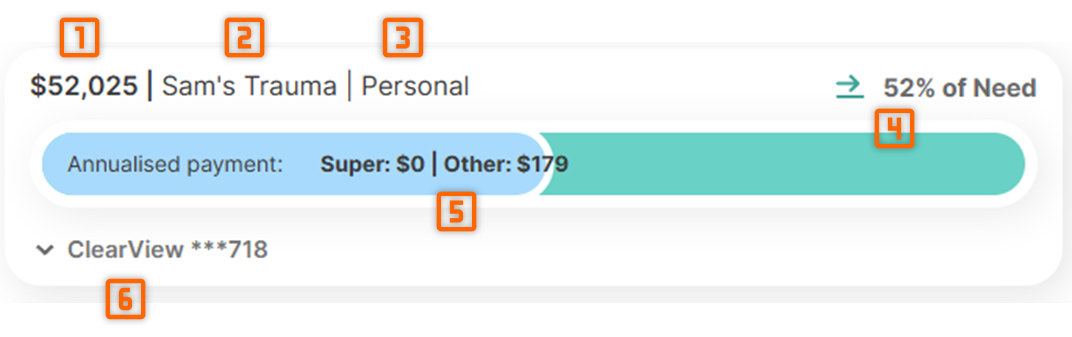
- Insured amount
- The sum insured for the type of policy for the insured individual (2) for a specific purpose (3).
- Life insured and cover type
- The life insured and type of insurance for a specific purpose (3).
- Cover purpose
- The purpose of the policy, e.g. Personal or Key Person, etc.
- Coverage ratio
- A percentage of the insured amount relative to the associated insurance need.
- The bar's fill is also based on this percentage.
- The above example depicts a case where the client is underinsured for this type of cover and policy purpose. The graphic colours and styles will changed for cases of over insurance, no insurance needs analysis, and no cover associated with insurance need.
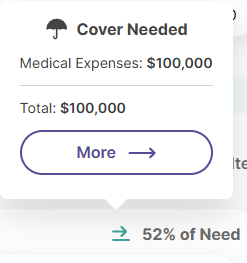
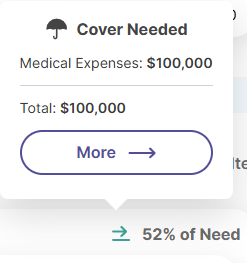
- Clicking the bar brings up a summary of the calculated insurance need:
- Annualised premiums
- Annualised premiums and whether they are funded from superannuation or not.
- For superannuation premiums paid by partial rollover, the premium is shown net of tax rebates.
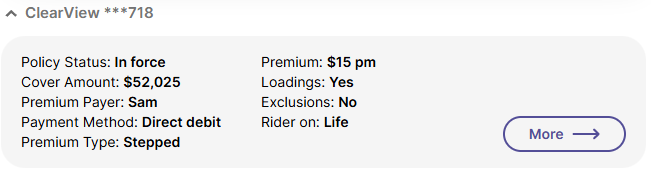
- Underlying policies
- All insurances for the reported policy type, life insured and policy purpose is listed here.
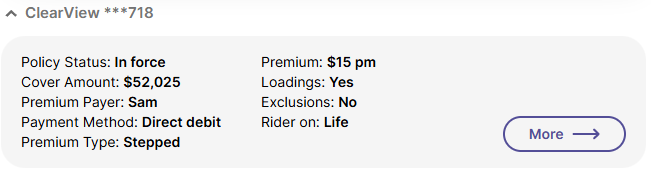
- Clicking a policy will show the core details of the policy.
Policy Grouping Logic
Beegle uses three criteria to group policies and insurance needs calculations:
- The type of policy
- The insured individual
- The purpose of the policy
This allows advisers to separate insurance needs and policies for business and personal purposes, and therefore properly assess the level of cover relative to insurance need for each.
Multiple Policies or Calculations
It is possible to have multiple policies or insurance needs calculations for each of the policy groups (defined above). Beegle handles these cases as follows:
- Insurance needs calculations
- All records are summed, regardless of the type of policy.
- Lie insurance
- All policy benefits are summed
- TPD insurance
- All policy benefits are summed
- Trauma insurance
- All policy benefits are summed
- Income Protection insurance
- Determines the shortest waiting period across policies and sums all benefits, including superannuation contributions covered, for that waiting period.
- Policies with a longer waiting period than the minimum are reported in the list of policies, but not included in the graphics.
- Essentially, the income protection benefits receivable the soonest are used to compare against the insurance needs analysis.
- Business Expense insurance
- Identical to income protection, except for the exclusion of superannuation contributions.